



Last week I had to conduct an executive interview. C-suite level. 45 minutes to evaluate someone who’d led multiple companies to success.
I’d never interviewed for this level of role. Ever.
Most people would’ve Googled ‘CEO interview questions’ and hoped for the best. That’s exactly how you get played by someone with media training.
Instead, I asked AI to design three questions that would cut through the polish. But here’s what melted my brain: it asked if I wanted to roleplay it first.
For 20 minutes, AI played the executive candidate. Gave me polished non-answers. Redirected my questions. Used all the tricks. Then it stopped and said: ‘Here’s where you let me off the hook. Here’s what you should’ve pressed on. Here’s the follow-up that would’ve exposed the gap.’
I walked into that real interview completely different. Confident. Prepared. I knew exactly when I was getting a rehearsed answer because I’d already heard it from AI.
The person sitting across from me had 20 years of experience. I had 20 minutes of AI roleplay.
Guess who controlled that interview?
Your competitor is having that same conversation with AI right now. About your customers. Your market. Your weaknesses.
But you’re still worried AI is “too complicated.”
The Tool Users vs. The Tool Fearers
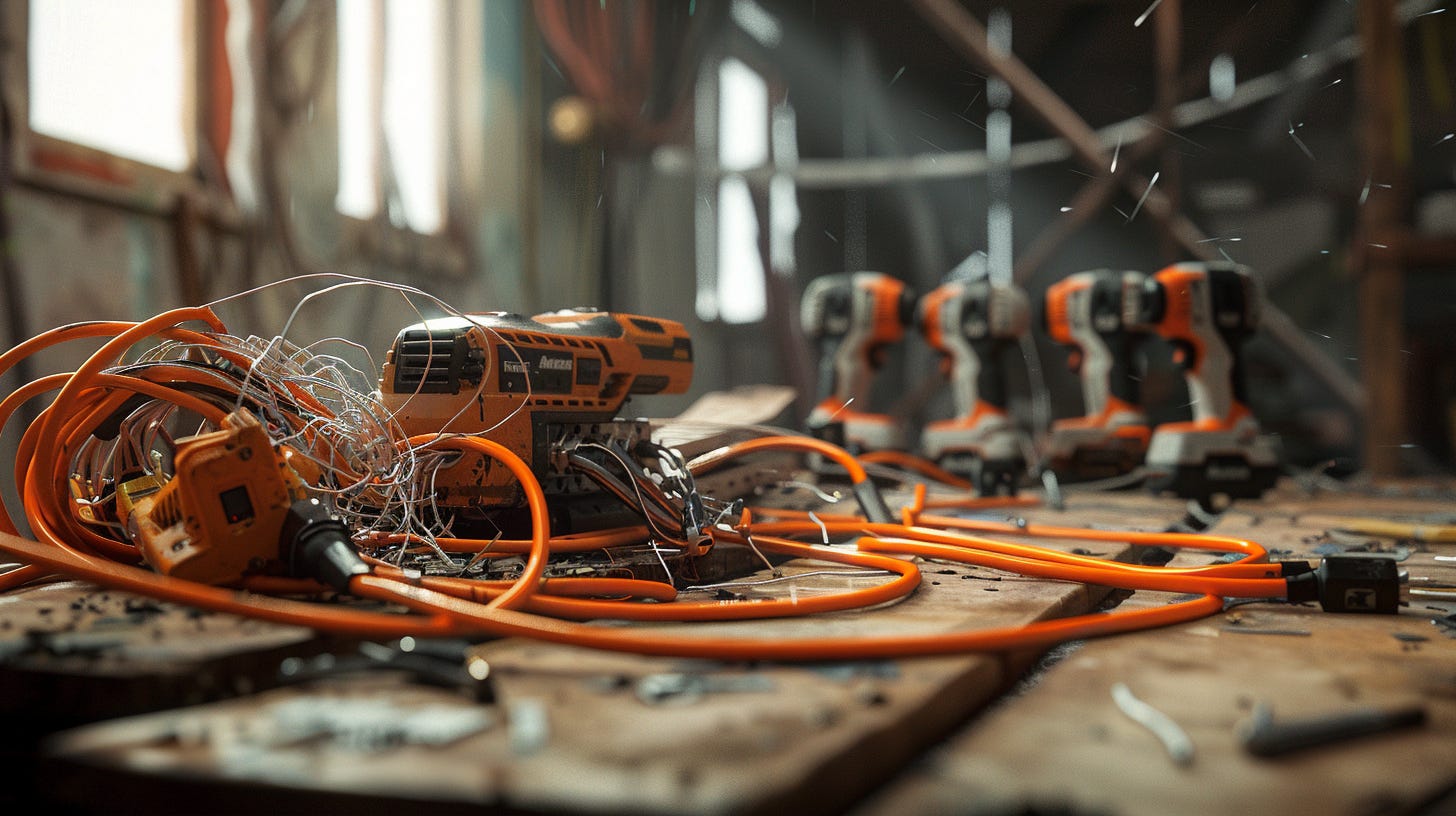
Every massive shift in human advantage came from someone picking up a tool that others feared.
1992. Construction site. One guy shows up with a battery-powered Makita saw.
You should’ve heard the shit he took.
“What happens when your battery dies, princess?” “Real contractors don’t need toys.” “Your wife called the office, she wants her vibrator back.”
Every coffee break. Every project meeting. Someone had a joke about his “purse-sized saw.” The foreman called it a homeowner tool. The old-timers said it would never have the power for real work.
That guy is retired now.
The ones who mocked him? Still working. Still bitter. Probably complaining about how “nobody wants to work anymore” while watching younger crews finish jobs in half the time with—you guessed it—battery everything.
The shift didn’t happen overnight. It happened one contractor at a time, realizing that five battery packs and no extension cord meant finishing two jobs while everyone else finished one.
Now here’s the part that should scare you: You’re not the guy with the Makita. You’re the guy mocking him.
Except this time, the tool isn’t a saw. It’s AI. And the job site is every industry on Earth.
Your competitor already bought their Makita.
You’re Already Behind (And Don’t Know It)

While you’re reading this, someone just used AI to:
Write a grant proposal for agricultural funding that addresses every criterion the reviewer looks for
Diagnose why their tractor’s hydraulics are acting up (with follow-up questions a mechanic would ask)
Create a crop rotation plan optimized for their exact soil conditions
Draft a purchase agreement that protects them in ways they wouldn’t have thought of
Research and negotiate the best price on equipment by knowing exactly what questions to ask
Last night, I needed a new TV. Could’ve spent three hours reading reviews, comparing specs, getting decision fatigue.
Instead, I asked AI.
It asked me: What room? How far do you sit? What’s the lighting like? Where are the windows? Do you watch sports or movies? What pisses you off about your current TV? What’s your actual budget—not what you tell your wife?
Five minutes. It gave me one TV. Not ten options. One. With exactly why it would solve each of my specific problems. I found it two minutes later online with free shipping. It was perfect.
The old me would’ve bought the wrong TV. Again. Like I did the last three times.
But here’s what really messes with my head: While I was buying that TV, someone else was using the same tool to find new customers for their business. To solve supply chain problems. To write contracts. To interview candidates.
They’re not smarter than you. They’re not more tech-savvy. They just started yesterday instead of tomorrow.
And tomorrow, they’ll be two days ahead.
The Simplest Power Move You’ll Make This Year

Here’s what pisses me off about my own industry: We’ve built technology that could transform how people manage money, but we’ve made it so complicated that only nerds like me can use it.
Decentralized finance. Smart contracts. Layer 2 solutions. We act like people need a PhD to participate.
It’s the same gatekeeping bullshit. Just with different vocabulary.
But here’s what I learned: Complexity is a choice. And AI just made it optional.
Watch this:
Hey AI, I need to write a proposal for a new customer to upgrade their HVAC. They’re skeptical about the cost. Help me write it.
AI writes it. Fine. Anyone can do that. But here’s the power move nobody’s making:
Now pretend you’re the customer. Read this proposal and tell me every reason you’d say no. Be harsh. Be unfair. Be exactly like a skeptical buyer who’s been burned before.
AI tears your proposal apart:
“Your ROI timeline assumes perfect conditions”
“No mention of maintenance costs after year one”
“Where’s the warranty details?”
“What if I need to expand in two years?”
Ok, rewrite the proposal addressing every one of those objections. But don’t make it obvious I’m defending. Weave it in naturally.
Boom. You now have a proposal that handles objections before they’re voiced. Your competitor has a Microsoft Word template from 2015.
Who’s winning that deal?
And you did this in ten minutes. On your phone. While having coffee.
Your customer thinks you’re psychic. You just asked better questions.
Your Competition Hopes You’ll Keep Waiting

I moved to Ontario two years ago from Arizona.
In Arizona, my crew was different. Entrepreneurs. People who trained at 5am before building businesses. People who read earnings reports for fun. People who saw problems as puzzles, not roadblocks.
Two years in Ontario. Know how many people like that I’ve found?
Zero.
At first I thought it was the town. The culture. “It’s just different here.”
But yesterday I joined the Chamber of Commerce. Started actually looking. And I realized something that made me feel like an idiot:
The adapters, the builders, the edge-seekers—they’re here. They’re just speaking a different language. Using different tools. Solving different problems.
They’re not hiding. I just wasn’t recognizable as one of them.
Because while they were adapting—while they were learning AI, automating their operations, solving tomorrow’s problems—I was waiting. Waiting to “find my people” instead of becoming visible to them.
The dividing line isn’t geography. It’s not industry. It’s not even education.
It’s this: Are you someone who picks up new tools, or someone who mocks them?
Are you the person learning AI to solve problems, or the person insisting “that’s not how we do things”?
Are you the battery-saw guy, or are you still dragging extension cords?
Your competition hopes you’ll keep mocking. Keep waiting. Keep insisting that “real business” doesn’t need these tools.
They’re counting on it, actually.
Start Badly. Today.

You don’t need to be good at this.
That’s what nobody tells you. My first AI conversation was me asking it to explain what a blockchain was. Like I didn’t already know. I was just testing if it would give a stupid answer.
It didn’t.
My second conversation was asking it to help me write an email I’d already written. Just to see the difference.
My tenth conversation saved me three hours of work.
My fiftieth changed how I run my entire team.
Here’s the thing about being bad at AI: You’re still ahead of everyone who hasn’t started.
So start stupid. Right now. Today. Here:
1. Ask AI to help you write one email. Any email.
The one you’re dreading. Copy, paste, send.
2. Tell it what you do for work in the simplest terms. Then ask:
What’s something AI could help me with that I haven’t thought of?
Be prepared to feel stupid when it’s obvious.
3. Use this exact prompt:
I need to buy a [thing you need]. Ask me questions until you know enough to recommend the perfect one.
Then actually buy what it recommends.
Three conversations. Three different types of help. You’ll see the pattern.
Remember that interview I opened with? The one where I controlled the conversation despite having zero experience?
That was my 200th AI conversation. Maybe my 300th.
But it started with conversation number one. Which looked a lot like: “This is probably stupid, but...”
Your competitor started their first conversation six months ago.
When are you starting yours?
Tomorrow, you’re either 24 hours behind or 24 hours ahead. The only difference is whether you close this article and forget it, or open AI and ask it one question. Just one. Here, I’ll make it easy. Copy and paste this:
I run a [your business/role] in [your town]. Everyone says AI will change everything but I don’t see how it applies to me. Can you give me one specific way I could use AI tomorrow that would actually matter? Not theory. Something I can actually do.
Send that. See what happens.
Then come find me and tell me what you discovered. Because people who take action on new tools? Those are my people.
Maybe they’re yours too.
Couldn't agree more. What specific promt yielded such advanced strategic feedback?